
Discover the importance of a vapour barrier on your flat roof
The Vapour Barrier
When you are having your flat roof installed, most often people will ask, “How will it be insulated?” Nobody wants a room that’s going to get damp and mouldy, particularly in areas where family gatherings are commonplace in open plan living areas, kitchen extensions and offices spaces for example. The most usual installation these days would be a warm flat roof to keep your room warm and dry and protected from the elements. This roof structure should also have a very important layer of protection called the Vapour Barrier.
The vapour barrier - on warm and cold flat roofs
Warm flat roof
warm flat roof installation is the most usual and effective method used today, and with it the vapour barrier is installed on the warm side of the insulation (in other words, on the room side of the insulation). This will then restrict the flow of warm moist air from entering the structure, and so protect the room from getting damp and mould.
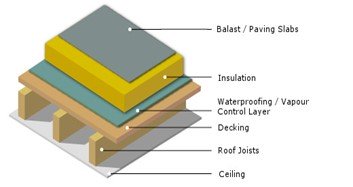
Technical Installation Layers
In a warm flat roof build, the layers are installed in this specific order (from the room upwards):
-
Roof Deck: The structural timber (usually OSB3 or plywood) that everything sits on.
-
Vapour Control Layer (VCL): A high-performance membrane laid directly onto the deck to prevent internal water vapour from rising.
-
Rigid Insulation: Usually PIR boards These are laid over the VCL to keep the entire roof structure at the same temperature as the room.
-
Waterproof Membrane: The final “weather” layer (such as EPDM rubber or Single ply) that protects the building from rain and UV rays.
Think of a warm flat roof like wearing a woolly jumper under a raincoat. To stay dry, you need a vapour barrier on the warm side of the insulation to act as a shield. It blocks the warm, moist air from your room from escaping into the roof structure.
While we use “wicking” fabrics for clothes, a roof barrier does the opposite: it’s a total stop-sign. It prevents damp and mould from nesting in your insulation, keeping your home’s “jumper” bone-dry.
Cold flat roof
Cold Flat Roof Structure
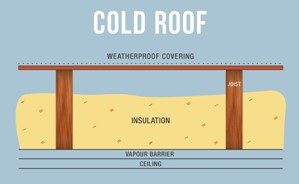
To sum things up, the vapour barrier will prevent condensation from entering your walls and ceilings which can over time cause damage to the building materials and plasterboard in your roof structure. It will also prevent damp from penetrating the insulation, therefore cutting down on heat loss going through your roof and saving on energy bills.
FAQs
It provides a very important layer of protection
These days more and more of us are having flat roof extensions to use as offices, utility rooms, bedrooms, and open plan living spaces for the family – basically where people gather, and a very important layer of protection to add to the components of your roof structure will be the Vapour Barrier.
A vapour barrier helps to prevent mould
The vapour barrier will wick away moisture, which will help to avoid any development of mould and mildew. From a health perspective, this is good news for those who may suffer from breathing or respiratory difficulties such as asthma.
It helps to prevent water vapour from seeping into the building materials
The vapour barrier is considered as an important component because it helps to stop water vapour from entering building walls, ceilings, attics and roofs which eventually causing building materials to rot.